Where the industry stands
Every Tier-1 vendor has an agentic announcement. Every hyperscaler has a telco AI platform. Every operator has a press release about an AI partnership. The language is confident: autonomous networks, self-healing operations, closed-loop optimisation, Level-4 autonomy.
Almost none of it exists in production in the form the marketing implies.
The numbers say so plainly. In late-2024 conversations with 88 operators, Andover Intel found just two running an operational digital twin, none of which spanned the whole network. Dell'Oro puts the industry in the Level 1-2 range, where automation is still domain-specific and most deployments are confined to single use cases rather than network-wide autonomy. TM Forum has validated dozens of Level-4 results, but each is locked to a single domain, for example RAN energy efficiency or service assurance, not the cross-domain autonomy the rhetoric suggests. Only about 4% of operators say they have reached Level 4 at all, and most now target 2030.
That is the real landscape beneath the headlines.
Inside it, the same word, 'agentic', is being used for two different transitions, and conflating them is where most of the confusion starts. The shift that matters here is from AI as assistant to AI as agent, from a system that drafts and suggests to one that decides and acts. That shift is happening in two places at once.
The first is operational autonomy: systems that reason about network state, evaluate changes against a digital twin, and score risk before touching the live network. Real in a small number of environments. Everywhere else they are experimental, heavily constrained, or gated by human approval at every meaningful step.
The second is software autonomy: AI that designs, generates, tests, and iterates on operational tooling with minimal human intervention. Outside telecom this is already reshaping how software gets built. Inside telecom it is still rare.
Both share a direction, moving from assistant to agent, but nothing else. Different constraints, different failure modes, very different timelines. I am holding them in one post because, in practice, they converge: the network agents and the factory that builds them are two halves of the same system.
This post is about what is real in each, where the industry actually stands, and which parts of the stack genuinely change once AI moves from assistant to agent.
The previous post was about why the foundations matter. This one is about what becomes possible once they exist.

Shift 1: Reasoned optimisation on a real digital twin
What "digital twin" mostly means in vendor materials today
When a telco vendor says "digital twin", they almost always mean one of four different things:
- A pre-deployment planning tool: 3D site capture, drone-scanned tower imagery, BIM models, RF planning before equipment goes in. Real and useful, but not coupled to anything that runs after the site goes live
- A live-monitoring rebadge: PM/CM/FM dashboards over a federated database, called a twin because the data finally sits in one pane. It reflects state, it does not model behaviour
- A lab emulation environment: Genuine network-behaviour modelling, but built for pre-production testing of vendor software releases, not coupled to live optimisation
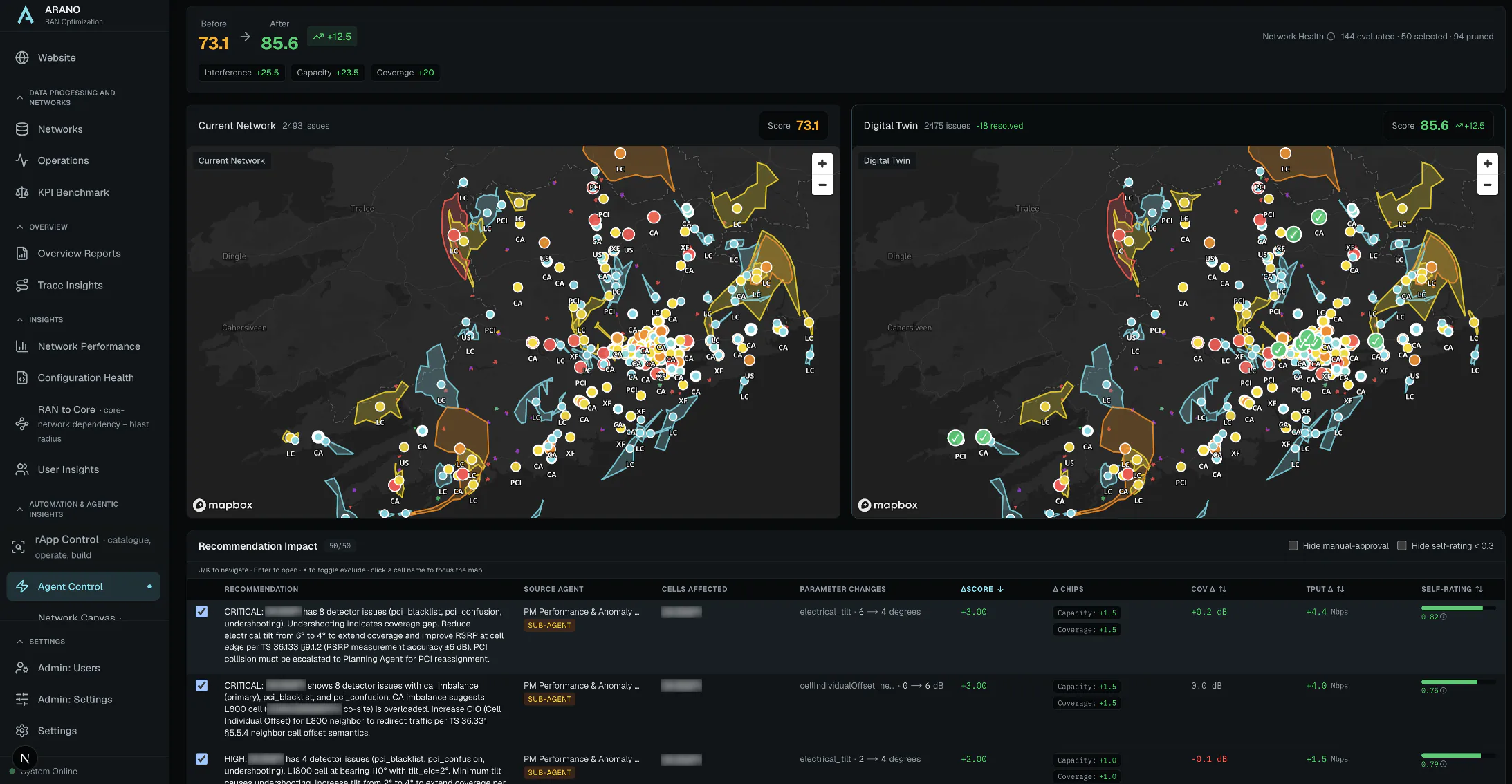
- An actual closed-loop production twin: A model rich enough to project the impact of a candidate change (propagation, interference, KPI delta) before it touches anything. The change is scored in the twin, then applied to the live network with the gate wherever the operator has set it, and unattended for the change classes that have earned it. This is the shift, and it is genuinely rare
The fourth category is the one most "AI-native network" marketing implies, and the gap to the first three is the whole story. At true Tier-1 operator-scale there are only a small handful of genuine production deployments globally, concentrated in Asia (most clearly China Mobile's Henan deployment with Huawei), all named operator partnerships and none with full network coverage. ARANO runs the fourth category in production today, not yet at national Tier-1 scale, but with the twin genuinely sitting between the agent and the network, which is the part that is still rare in production. And it is built to run the full autonomy span: human-in-the-loop on day one, closed loop at L4/L5 once an operator trusts it. The question is never whether a human approves, but how much they still need to.
The old loop
The traditional optimisation loop is human-paced. An engineer watches a dashboard, notices a degradation, forms a hypothesis, and changes a parameter, such as power, tilt, a neighbour list, or a handover threshold, in the vendor's element management tool. Then they wait for the change to propagate, which can take hours, look again, and either move on or try something else.
A single engineer paying close attention can hold maybe fifty cells in their head this way. A typical operator has tens of thousands.
The traditional answer to that gap was rule-based SON: Automatic Neighbour Relations, Mobility Load Balancing, Mobility Robustness Optimisation, and the rest. These genuinely work for the common cases at scale, and they are still doing real work in live networks today. But they hit a structural ceiling. Each feature was siloed, and coordination between them was handled by pre-emption matrices, static priority rules deciding which feature wins when two want to act on the same cell. As feature count and interaction complexity grew, that model broke down. A rule-based MRO algorithm has no idea that the neighbouring cell took a CM change yesterday that explains why today's handovers are failing. What was missing was the ability to reason across the domains, not just within them.
What a real closed-loop twin actually does
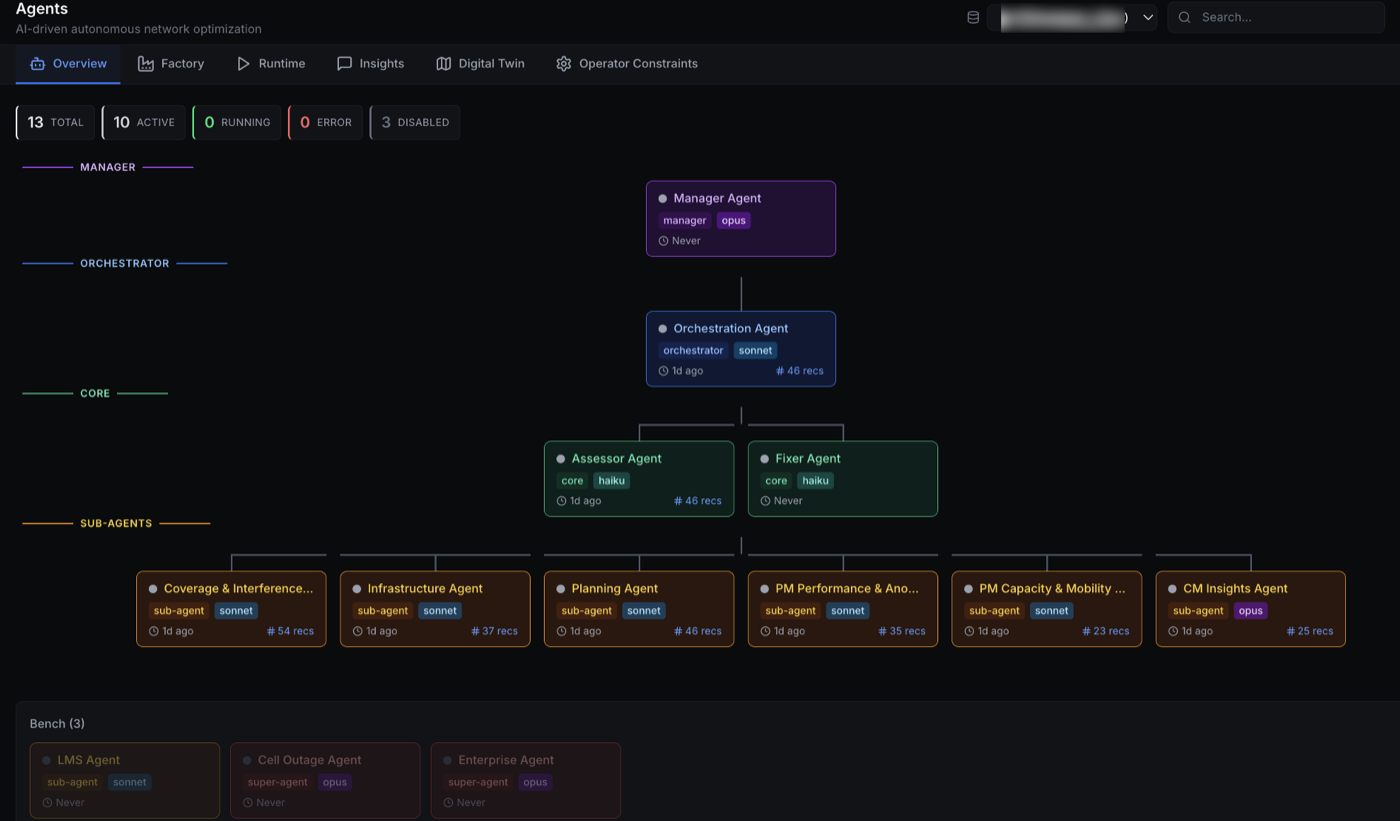
When the agentic layer evaluates a cell, it reads the deterministic issue-detection outputs, the recent PM trends, the CM history, the FM activity, the mobility pattern, and the trace-grounded coverage shape, all in parallel. It can see that yesterday's CM change correlates with today's handover failures, and it writes up that reasoning in language an engineer can audit.
It then proposes changes, which are applied first inside the twin. What the twin models depends on the kind of change:
- For coverage changes (power, tilt), it projects propagation and SINR through a calibrated path-loss model and derives the resulting KPI delta
- For mobility and parameter changes (neighbour lists, handover thresholds), it models the effect on the mobility and handover-success behaviour, a different model for a different failure mode
In both cases the twin is only as trustworthy as its calibration. The model is grounded against real measurement data and its projections are back-checked against realised KPIs after changes apply, so the twin stays honest about the network it claims to mirror. That calibration loop is what lets the twin act as a trust gate rather than a guess, and, as we will see, it is also what lets a human safely step back from the gate over time.
The twin does not test changes one at a time. It scores them in bulk, the full set of proposed changes evaluated together across multiple dimensions of network health, because a change in one cell shifts the optimum in its neighbours. The agent then hands over a ranked set of recommendations, each carrying the twin's projection.
At the early adoption stage, an engineer sits at the gate. They have all of that context in front of them, every change, every projection, the reasoning behind each, but they do not work through it change by change. That would put us straight back at human pace. They review at the level of the outcome: does the projected end-state make sense, do the changes stay inside the guardrails, does anything regress past a threshold. Approve, and a downstream process pushes the batch to the vendor element management. Reject, and the agent re-runs. The context is there to audit. Consuming all of it, line by line, is not the job.
This is reasoning-based optimisation: bounded by guardrails, with the gate wherever the operator puts it. It is not rule-based, and it is not unconstrained. Whether it runs autonomously is a dial, not a fixed property, and that dial is the whole story of how operators adopt it. Underneath, it is an engineer doing per-cell-quality reasoning at per-network scale, reviewing the twin's scored result rather than refereeing every move.
At scale: where SON coordination disappears
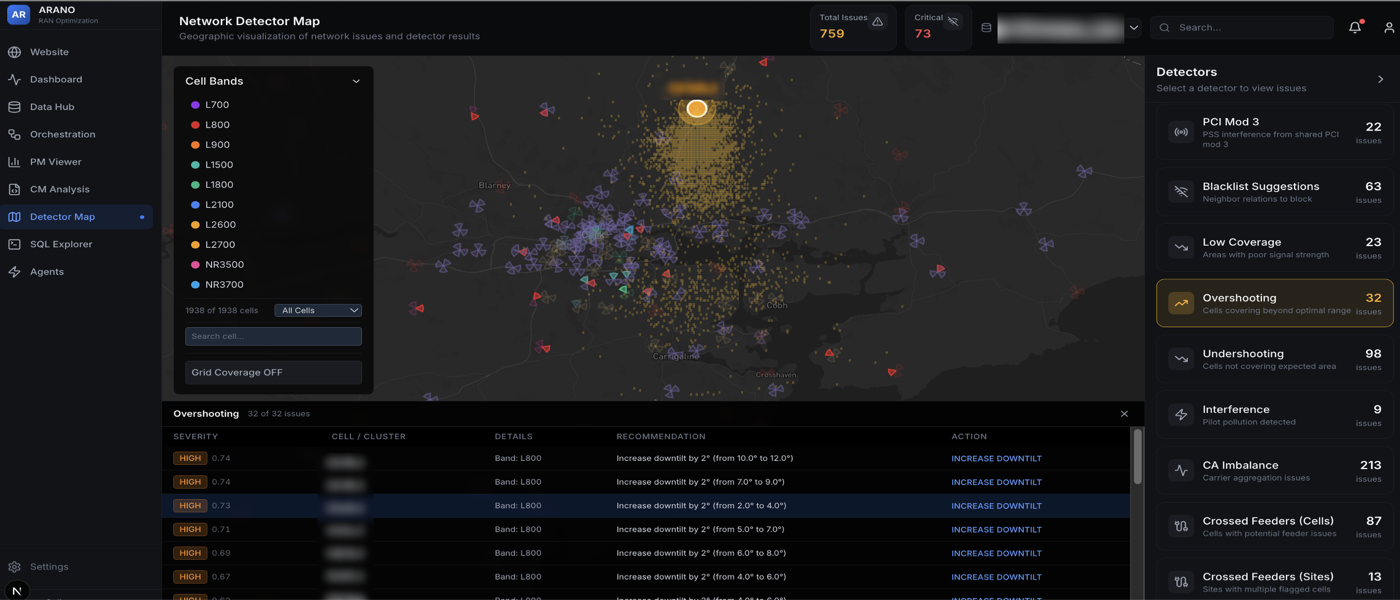
Now picture a network with thousands of concurrent issues across multiple domains. The agentic layer's job is to find the best combined solution for the whole set in each iteration. It tests different combinations of changes against the twin until it reaches the highest global score.
This is the part that matters most. Conflict resolution stops being explicit. There are no hard priority rules about which feature outranks which, no pre-emption matrices, no manual SON coordination, because the twin's scoring function resolves conflicts implicitly, by evaluating combined outcomes against a single network-wide objective. The thing that used to require a static rulebook is now an emergent property of scoring candidate states.
And the guardrails are the same artifact whether a human enforces them or the agent does. The projected KPI envelope, the constraint that no individual cell regresses past a set threshold, the bound on how much can change in one window: at human-in-the-loop the engineer approves against those bounds; let the system run inside them and you have closed loop. The guardrails do not change as the network climbs toward autonomy. Only who enforces them does.
Climbing the ladder: from human-in-the-loop to closed loop
Who enforces the guardrails, and how far the guardrails are pushed, is the dial operators actually turn, one rung at a time. An operator starts with the engineer approving every batch: full human-in-the-loop. As the twin's projections prove out against realised KPIs, change class by change class, the gate relaxes. First to review-by-exception, where the agent applies what sits cleanly inside the guardrails and escalates only what does not, and eventually to closed-loop autonomy (L4, then L5) for the categories that have earned it. Energy-saving tilt changes might run unattended long before anyone lets the agent touch a feature rollout. Nobody jumps straight to fully autonomous. The twin is the constant. The amount of human gating is what moves, and only ever after the track record exists to justify it.
This is what ARANO does today, with the twin between the agent and the network, and built to run the whole ladder rather than lock the operator at one rung.
What changes for the industry, when this stops being rare
When closed-loop twins move from rare to common, three things shift.
Change windows shrink from weeks to hours, because the reasoning step that used to take an engineer an afternoon takes the agentic layer a minute. SON moves from rule-based to reasoning-based, with the twin as the trust gate instead of a static priority matrix, and the L3 to L4 to L5 climb stops being a roadmap milestone and becomes something an operator dials in per domain, as the twin earns it. The "one engineer per N cells" staffing ratio breaks, because the agent holds the cross-domain context the engineer could never fully hold.
What does not change, at any rung, is accountability. The agent reasons, scores, and proposes. The operator decides how much human approval to keep in the loop. And the operator remains responsible for what runs on the network, whether a human approved the batch or the system did. The autonomy dial moves. Responsibility does not.
Shift 2: Autonomous coding and the feature pipeline
What "agentic AI in telecom" mostly means today
The agentic-AI announcement noise in telecom is loud right now. Decoded, almost every announcement is one of three things:
- A chatbot on top of RAG: Useful for ops queries. Not agentic in any meaningful multi-step sense
- A single-LLM-with-tools for ops queries: Operations Assistant, Autonomous Data Steward, Network Operations Agent Framework. More capable than RAG. Still mostly read-only or human-confirmed for any write
- Multi-agent autonomous loops with safety stacks: The named-operator-shipping evidence is thin, and today any radio-parameter write still goes through explicit human approval. That is where everyone starts. Shift 1 is the story of how that gate rises over time, but right now almost no one has moved off it
Gartner predicts that over 40% of agentic AI projects will be canceled by the end of 2027, citing escalating costs, unclear business value, and inadequate risk controls. The wall-to-wall L4 networks promised for 2025 have largely slipped. This is not to say agentic AI in telecom is not real, pieces of it are. But the picture is much smaller than the marketing implies, and almost none of it touches the autonomous software-development loop that is the second shift.
The old loop, in software delivery
The traditional feature-development loop in telecom software is vendor-paced. An operator sees a need: they want a feature to investigate a specific failure mode, or a KPI specific to their environment, or a fix for a counter that drifted in the last vendor release. They file a request with their vendor. The vendor evaluates the request, slots it into a roadmap, builds it over months, and ships it in a quarterly release. Total elapsed time is six to twelve months.
For the operator, that is a quarter or two during which the failure mode keeps producing tickets, the KPI keeps being approximated, and the drifted counter keeps producing noise.
This was tolerable when vendors were the only entities capable of writing software against operator data. It is no longer the case.
What autonomous coding looks like, and who is actually doing it in telco
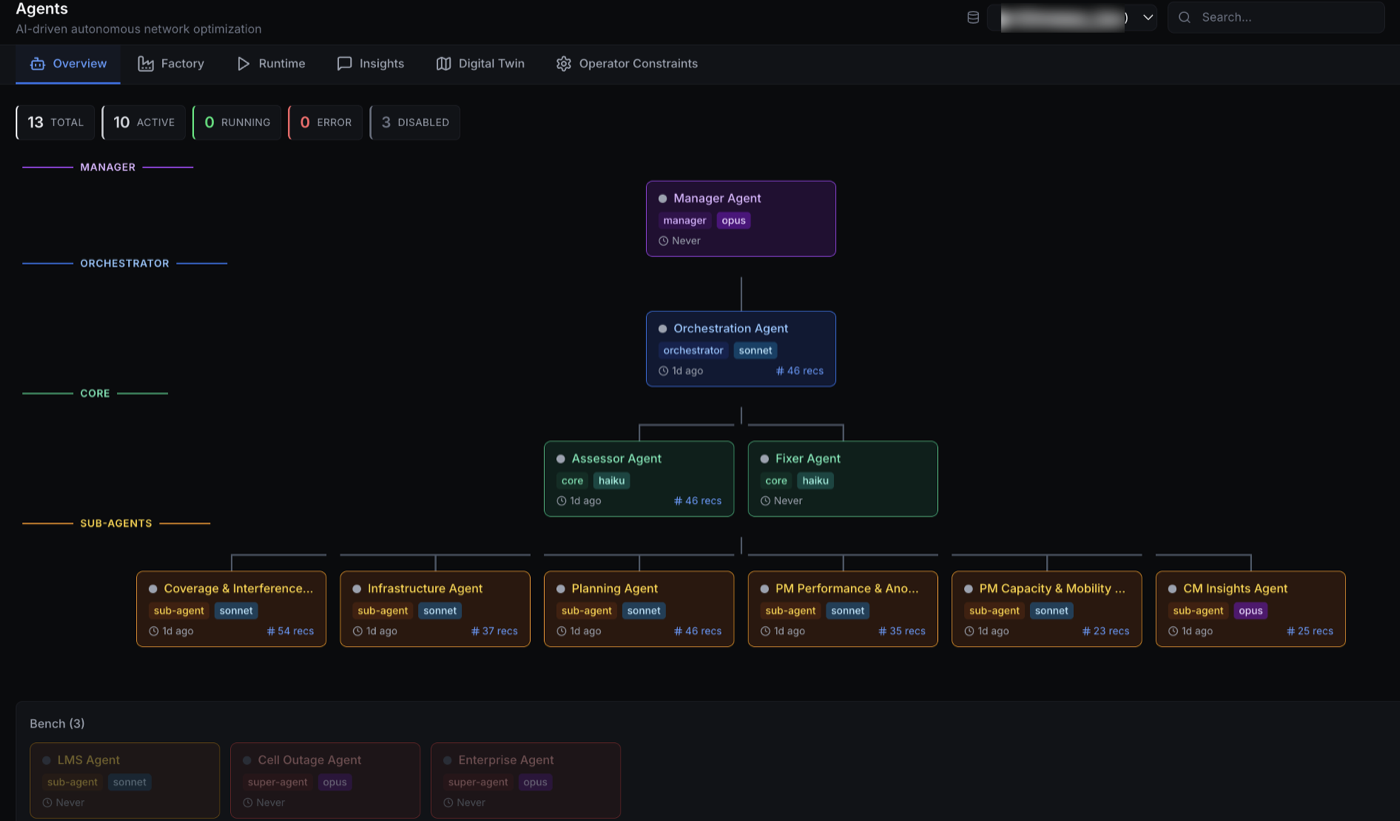
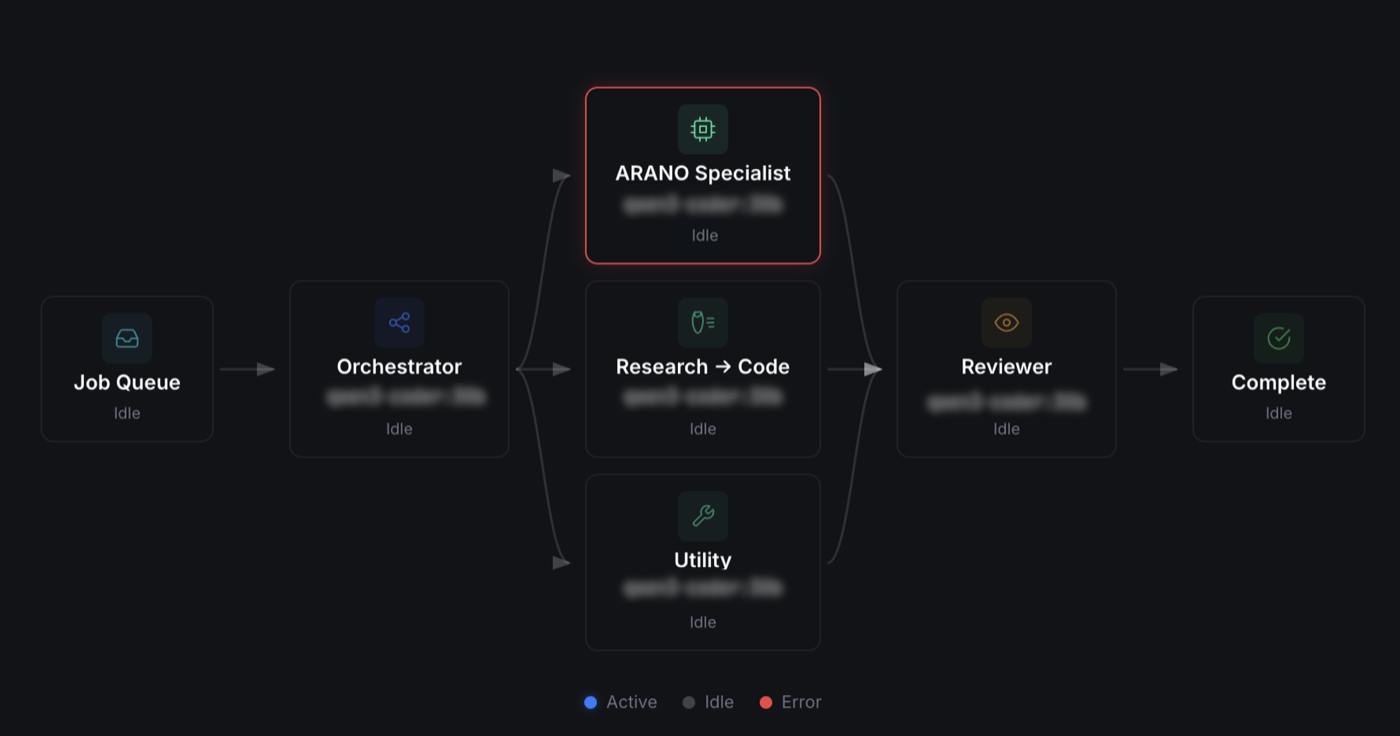
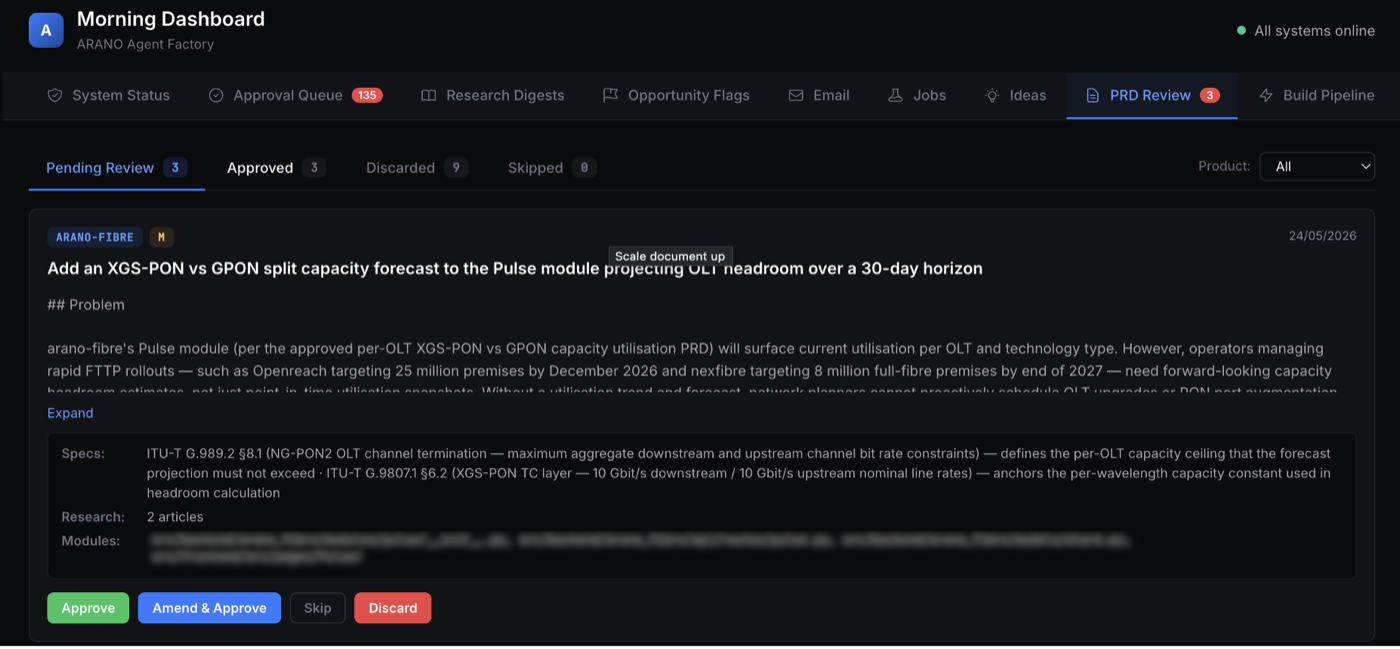
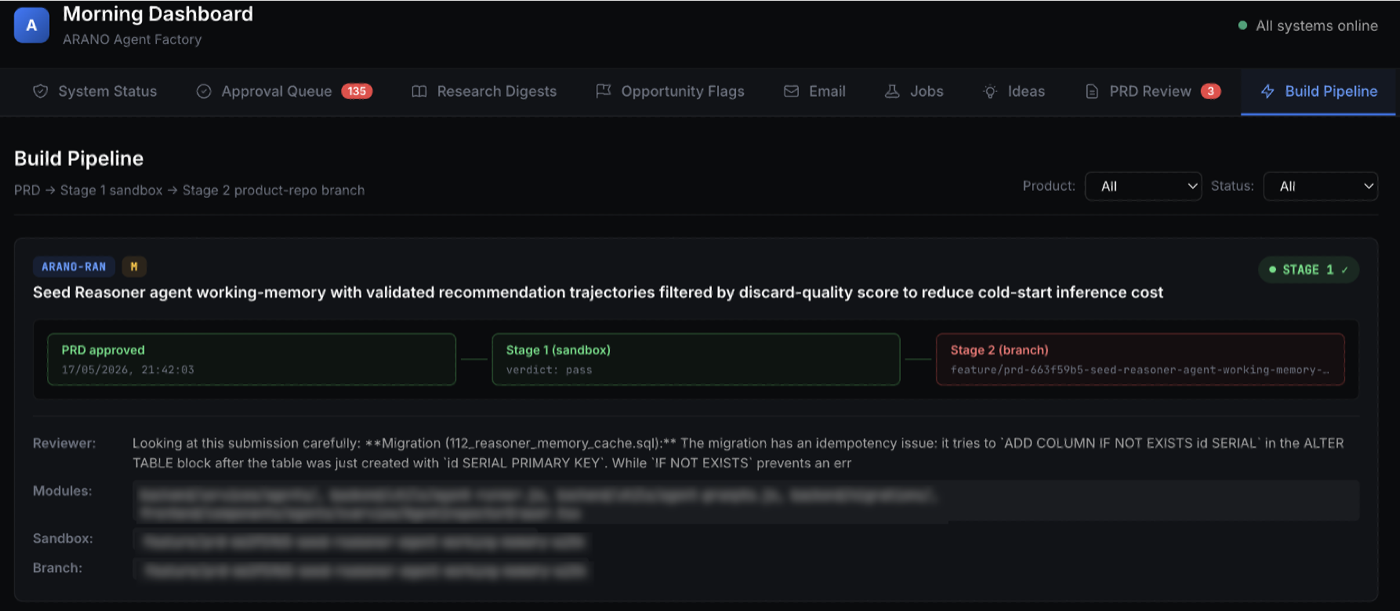
The new pipeline shape: an engineer writes a PRD, a structured problem statement describing what they want and why. The PRD goes into an autonomous coding pipeline. A specialist agent reads the PRD, writes the relevant code, and opens a draft pull request. A reviewer agent checks the work. A human approves the PR or sends it back. The whole loop takes hours to a day, not months.
The work the specialist does is constrained. It cannot modify authentication code. It cannot exceed a small number of files in a single change. It cannot auto-merge. It writes against a frozen, reviewed PRD, and if the PRD itself was vague, an earlier critic step would have caught that. The trust comes not from "the model is smart enough" but from a stack of guardrails that close off the silent failure modes.
Outside telecom, this is becoming common: Codex, Claude Code, GitHub Copilot Workspace, Factory AI. Inside telecom, it is not. As of mid-2026, based on public materials and several hours auditing competitor positioning across the major vendors, hyperscalers, and operators, I cannot find a single telecom vendor or operator that publicly markets a PRD-to-PR autonomous coding pipeline running on their own RAN-domain product.
The closest adjacent activity, and none of it is that:
- Infosys + Anthropic (February 2026): Claude models and Claude Code integrated with Infosys Topaz, the collaboration beginning in telecommunications through a dedicated Anthropic Centre of Excellence before expanding to other regulated industries. This is a systems integrator helping clients build agents and accelerate delivery, engineers using a coding agent, not an autonomous factory shipping features into a productised RAN platform
- Infosys + NVIDIA NeMo: a compact 2.5-billion-parameter coding model built with NeMo and embedded in Topaz Fabric, supporting code generation and refactoring. A capable model offered as a tool, not a self-running PRD-to-PR pipeline on an optimisation product of their own
- Tech Mahindra + NVIDIA: a Network Operations reasoning agent (the Large Telco Model line) aimed at L4+ NOC automation, explicitly human-in-the-loop. This is operational autonomy, Shift 1 territory, not software autonomy. It does not write features
- Deutsche Telekom "AI Engineer": generates, documents, and tests code from a spec, but developers guide it, quality-check it, and decide how to integrate it. Developer-assist, not autonomous PR shipping
That gap is the second shift, and it is the one ARANO is most clearly differentiated on. The ARANO research and coding factory runs daily. It researches current developments across telecoms and AI, assesses them against the product codebase to find gaps, and autogenerates PRDs. After human approval, it autonomously codes, tests, and pushes the feature to the main codebase. The result is a weekly release cadence, not a quarterly one. Because the features are modular, upgrades stay contained and carry minimal regression risk. The platform was built from the ground up to fit this evolving agent model rather than having it bolted on later, and that is the real distinction. I will write a follow-up article explaining the process in more detail.
What it changes for the industry, if it generalises
Telecom software vendors stop setting the cadence for operator-specific features. The pace of that delivery is no longer fixed by what the vendor decided to prioritise this quarter. Operators become first-class authors of their own optimisation logic, detectors, and analytics. The vendor moat shrinks toward standards compliance, integration access, and the data they have direct visibility into, rather than the operator-specific feature backlog.
This is, depending on which side of the table you are sitting, either an opportunity or an existential change. An operator that builds this capability internally can iterate at the speed of its own thinking. A vendor that does not respond stops being competitive on cycle time.
Where ARANO actually sits on the map
The honest positioning, given the research above:
On the digital twin shift, ARANO is in the small set of platforms with a production twin that scores parameter changes against a propagation, SINR, and KPI model before commit. Its differentiation against competitors is an independent, multi-vendor stack, not tied to a single vendor's RIC or element management, and being available today rather than in the next product cycle.
On the autonomous coding shift, ARANO is, based on the public evidence I have been able to find, in a category of one inside telecom. The category exists strongly outside telecom. ARANO is the only place I have seen the pattern applied to RAN-domain software development.
On the broader "agentic AI for telecom" question, where the marketing noise is loudest, here is the honest part. Across the industry, writes to live network state go through human approval, and every credible player sits on that rung: Ericsson, Nokia, Mavenir, Rakuten Symphony, every operator with a TM Forum L4 assessment. ARANO does not hard-code it. The twin gate is mandatory and the human gate is a setting: a validated change goes to an engineer for review or straight to the operator's SMO, per change class, as the operator configures it. The difference is not who holds the line today. It is who has to re-architect to climb off it. What never moves is accountability, recommendations are scored and surfaced, and the operator owns what runs. Approval rises with trust. Responsibility does not.
The point is not that ARANO is "first" at anything. It is not. The point is this: the digital twin shift is real but rarer than vendors imply, the autonomous coding shift is real but nearly absent inside telecom, and a small team with the right safety stack can run further along both shifts than the marketing landscape suggests.
What still needs a human, today
It is worth being explicit about what agentic AI has not yet earned the right to do unattended.
A change class with no track record behind it still wants a person at the gate. That ladder is long and climbs one rung at a time, with months of supervised operation per rung, but it does climb, and where it has climbed the gate is already open. The point is not that the gate is permanent. It is that it is earned, never skipped, and never wider than the evidence.
It does not handle critical change windows alone. When the operator is about to make a structural change, a new band rollout, a vendor swap, a software upgrade, an agent's recommendation is one input among many, not the deciding voice.
Autonomy without an auditable reasoning chain earns nothing. "The model recommended it" is not what a network engineer says when challenged on a change. They say the model recommended it, the digital twin projection showed X, the recent trace data confirmed the hypothesis, and they checked the cell themselves. Today that chain is the engineer's. As the gate rises, the chain does not disappear, it has to be carried by the system and logged: the projection, the grounding, the scored alternatives. A system that cannot explain itself does not earn the next rung.
These bounds are not weaknesses of the technology. They are the shape of what trusted autonomy looks like in a regulated, safety-adjacent industry.
What has not shipped yet
A few things people have promised that have not arrived.
Full Level-5 zero-touch network operation is not here. Cross-domain L4 is not here at scale: the TM Forum L4 validations so far are domain-scoped, not wall-to-wall, and as noted earlier the industry still sits in the Level 1-2 range on the maturity curve.
Vendor-neutral live configuration is not here. Multi-vendor optimisation works at the agentic layer, but the layer below, the vendor element-management interface, is still proprietary, still drifts, and still needs per-vendor adapters. Open standards (O-RAN R1, A1) are improving this, but not fast.
Closed-loop machine learning on production telco data is not here at meaningful scale, because the data-access story is still hard. Operator data is NDA-bound, customer data is privacy-bound, cross-operator pooling is regulatory-bound. Reasoning-based agentic AI sidesteps some of this, because it can reason from spec and shape rather than learning from raw cross-operator data, but it is not a full substitute.
And the autonomous coding pipeline, outside ARANO and the SI-led offerings, has not arrived in telco. That is the one I expect to move fastest over the next year. The barrier is not the technology. It is who is willing to run it inside a regulated software stack first.
Closing remarks
Telecom has been a slow-moving industry because the constraints are real. Standards bodies move slowly because they have to. Vendors move slowly because their customers cannot afford breaking changes. Operators move slowly because they answer to regulators.
What changed in the last eighteen months is that the cost of reasoning over the accumulated artefacts dropped to where small teams can do useful work. That is the actual shift. Reasoning is now affordable. Software delivery is now elastic. The shape of trusted autonomy is starting to be visible, slowly, unevenly, and not always where the marketing claims it is.
What did not change is that this is still a domain where being wrong costs real money and real availability. Agentic AI in telecom works because, and only because, it is bounded by the same operational discipline that has always made telecom safe. Without that discipline it would be a faster way to break things.
The honest question is not who is first, and it is not who can sit on the safe floor longest. It is who can climb off that floor without ever dropping below it, one earned rung at a time, with the accountability chain intact the whole way up. Gated where trust has not been earned, autonomous where it has, and never the other way around. That trajectory is where the real differentiation lives.
That is where ARANO is.
Sources
- Tom Nolle, "The Role of and Prospects for the Network Digital Twin," Andover Intel, 20 November 2024. https://andoverintel.com/2024/11/20/the-role-of-and-prospects-for-the-network-digital-twin/
- Stefan Pongratz, "Level 4 Autonomous RAN – From Vision to Early Reality," Dell'Oro Group, 2026. https://www.delloro.com/level-4-autonomous-ran-from-vision-to-early-reality/
- TM Forum, "Assessing CSPs' Progress Towards Level 4 Autonomous Networks," 2026. https://inform.tmforum.org/research-and-analysis/reports/assessing-csps-progress-towards-level-4-autonomous-networks
- "TDC NET and Ericsson achieve industry-first certification from TM Forum of Level 4 Autonomy," Ericsson, 19 June 2025. https://www.ericsson.com/en/news/2025/6/tdc-net-and-ericsson-achieves-industry-first-certification-from-tm-forum-of-level-4-autonomy
- Gartner, "Gartner Predicts Over 40% of Agentic AI Projects Will Be Canceled by End of 2027," press release, 25 June 2025. https://www.gartner.com/en/newsroom/press-releases/2025-06-25-gartner-predicts-over-40-percent-of-agentic-ai-projects-will-be-canceled-by-end-of-2027
- "Infosys and Anthropic Announce Collaboration to Unlock AI Value across Complex, Regulated Industries," Infosys, 16 February 2026. https://www.infosys.com/newsroom/press-releases/2026/advanced-enterprise-ai-solutions-industries.html
- "Anthropic and Infosys collaborate to build AI agents for telecommunications and other regulated industries," Anthropic, 17 February 2026. https://www.anthropic.com/news/anthropic-infosys
- "India's Global Systems Integrators Build Next Wave of Enterprise Agents With NVIDIA AI," NVIDIA Blog, 17 February 2026. https://blogs.nvidia.com/blog/india-enterprise-ai-agents/
- "Tech Mahindra Advances AI-Driven Autonomous Network Operations for CSPs Globally with NVIDIA," Tech Mahindra, 3 March 2026. https://www.techmahindra.com/insights/press-releases/techm-advances-ai-driven-autonomous-network-operations-csps/
- "Tech Mahindra to Transform Autonomous Network Operations with New Large Telco Model based on NVIDIA AI Enterprise and AWS Cloud Infrastructure," Tech Mahindra, 4 March 2025. https://www.prnewswire.com/news-releases/tech-mahindra-to-transform-autonomous-network-operations-with-new-large-telco-model-based-on-nvidia-ai-enterprise-and-aws-cloud-infrastructure-302391067.html
- "AI Agents: the AI revolution takes off," Deutsche Telekom, 14 August 2025. https://www.telekom.com/en/blog/group/article/ai-agents-the-ai-revolution-takes-off-1095226
Earlier in this thread: Fifteen years in the operator chair, compressed into ARANO.